

Welcome to the professional physiotherapy clinic
- Unit- 607, 2250 Bovaird Dr E, Brampton, ON, L6R 0W3
Welcome to the professional physiotherapy clinic
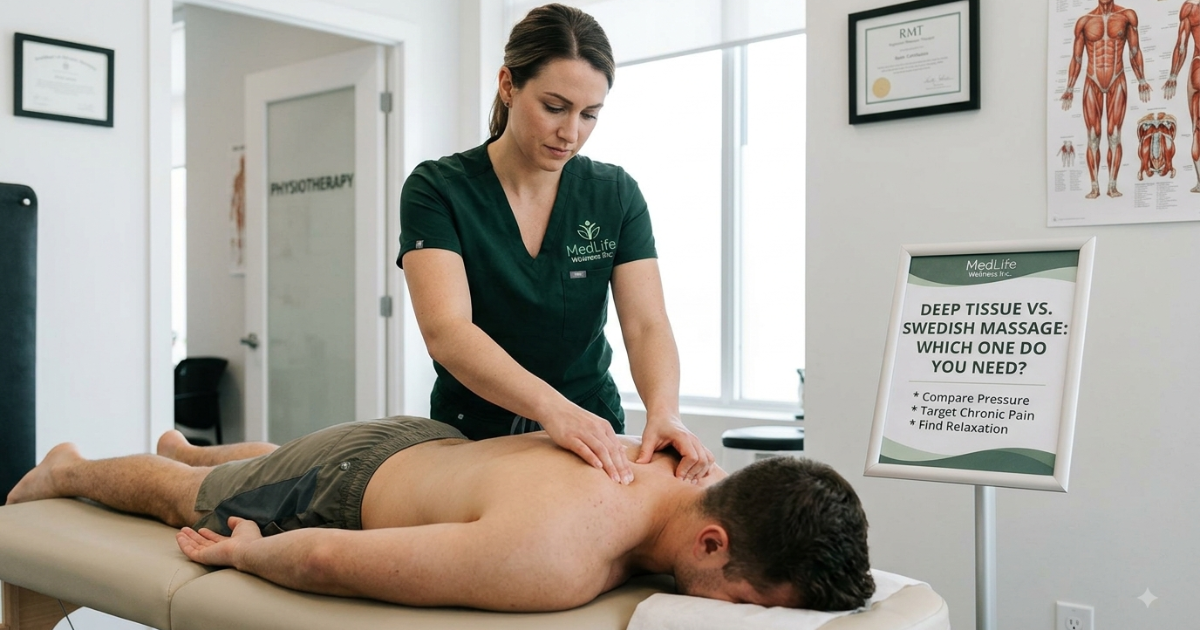
Stepping into a wellness clinic or scheduling a massage appointment often presents you with a menu of options. Among the list of offerings, two classic modalities consistently stand out: Swedish Massage and Deep Tissue Massage. While both are exceptional therapeutic tools designed to enhance physical well-being, they serve distinctly different goals, employ vastly different techniques, and target completely different layers of muscle tissue.
Choosing the wrong type of massage can leave you feeling either underwhelmed or unexpectedly sore. If you arrive with severe lower back knots expecting a therapeutic deep-tissue workout, a soft, soothing relaxation session may leave you feeling unfulfilled. Conversely, if you are looking to unwind after a stressful workweek, an intense, deep-pressure session targeting deep muscle bands might feel overwhelming.
At MedLife Wellness Inc., our team of Registered Massage Therapists believes that informed patients achieve the best clinical outcomes. This comprehensive guide breaks down the core physiological mechanisms, pressure dynamics, clinical benefits, and specific use cases of both modalities so you can confidently decide which treatment fits your body’s current needs.
Swedish massage is widely regarded as the foundational framework of modern Western massage therapy. Developed in the early 19th century, this modality focuses primarily on the superficial layers of muscle tissue, promoting full-body relaxation, easing mild tension, and boosting systemic circulation.
Unlike deep clinical treatments that target deep connective tissue, Swedish massage works harmoniously with your body’s central nervous system. By utilizing smooth, continuous, and rhythmic strokes directed toward the heart, it stimulates venous blood flow and activates the parasympathetic nervous system the body’s natural “rest and digest” state.
Every professional Swedish massage incorporates five core manual manipulation techniques, each serving a unique physiological function:
Swedish massage is far more than an indulgent pampering session it delivers tangible, research-backed physical and psychological health benefits:
While Swedish massage focuses on general relaxation and surface-level muscles, deep tissue massage is a targeted, therapeutic intervention designed to reach deep layers of muscle tissue, tendons, and surrounding myofascial structures.
When muscles undergo chronic stress, poor posture, repetitive motion, or physical trauma, they develop adhesions dense bands of rigid, painful scar tissue commonly known as “knots.” These adhesions restrict blood circulation, limit joint range of motion, trap nearby nerves, and cause persistent, aching pain.
Deep tissue massage utilizes concentrated, deliberate pressure and slow, deep strokes aimed directly across the grain of muscle fibers. Rather than working solely on superficial layers, the practitioner slowly sinks through top-level muscles to access deep structural tissue, breaking down stubborn adhesions and restoring normal elasticity.
Deep tissue massage goes beyond standard kneading. Practitioners at MedLife Wellness Massage Therapy utilize specialized manual methods to rehabilitate damaged tissue:
Deep tissue massage offers powerful structural benefits for patients managing persistent musculoskeletal pain:
To help you compare both modalities at a glance, the following table highlights their core differences across key clinical dimensions:
| Comparison Factor | Swedish Massage | Deep Tissue Massage |
| Primary Clinical Goal | Full-body relaxation, stress reduction, and surface blood flow | Targeting chronic knots, breaking scar tissue, and structural pain relief |
| Pressure Level | Light to moderate, comfortable, smooth pressure | Firm, deep, intense, and highly targeted pressure |
| Technique & Stroke Speed | Long, fluid, sweeping strokes, rhythmic kneading, light tapping | Slow, deliberate, concentrated strokes, cross-fiber friction, static pressure |
| Targeted Tissue Layers | Superficial muscle bellies and upper skin layers | Deep muscle layers, inner tendons, sub-layer fascia, joint capsules |
| Soreness After Treatment | Minimal to none; leaves you feeling refreshed and relaxed | Common mild muscle soreness lasting 24–48 hours (similar to post-workout) |
| Best Candidate Profile | First-time clients, stress relief seekers, individuals with low pain tolerance | Athletes, office workers with severe desk posture strain, chronic pain patients |
From an anatomical standpoint, both modalities communicate with your nervous system and circulatory pathways through distinct biological channels:
According to research reviewed by the National Institutes of Health (NIH) and clinical rehabilitation literature, soft tissue manipulation impacts both local chemical mediators and central brain processing.
Still wondering which treatment you should schedule? Consider these common everyday scenarios to identify the best fit for your current condition:
For individuals dealing with complex or multi-layered health conditions, combining massage therapy with other conservative clinical modalities yields the fastest and most sustainable recovery.
At MedLife Wellness Inc., our practitioners collaborate across disciplines to build comprehensive care plans. For example, pairing deep tissue massage with targeted Physiotherapy helps loosen restricted joints and tight muscles so you can perform strengthening exercises with proper form.
Similarly, patients receiving Chiropractic Care often find that receiving a massage prior to spinal adjustments relaxes surrounding spinal muscles, making joint realignments easier and longer-lasting. If your injuries are sports-related, integrating structured Sports Injury Management alongside deep tissue work accelerates tissue repair and prevents re-injury.
To get the maximum therapeutic benefit from your massage session and minimize any post-treatment soreness follow these simple clinician-approved aftercare tips:
Medical Disclaimer: The information provided in this article is for educational and informational purposes only and is not intended as medical advice. Always seek the advice of a qualified healthcare provider regarding any medical condition or treatment plan. Never disregard professional medical advice or delay seeking it because of something you have read on this site.
Whether you need deep structural relief or peaceful full-body relaxation, our expert Registered Massage Therapists at MedLife Wellness Inc. in Brampton are here to help.
Book Your Massage Therapy Session Today at MedLife Wellness Inc. or call our friendly team directly at Stepping into a wellness clinic or scheduling a massage appointment often presents you with a menu of options. Among the list of offerings, two classic modalities consistently stand out: Swedish Massage and Deep Tissue Massage. While both are exceptional therapeutic tools designed to enhance physical well-being, they serve distinctly different goals, employ vastly different techniques, and target completely different layers of muscle tissue.
Choosing the wrong type of massage can leave you feeling either underwhelmed or unexpectedly sore. If you arrive with severe lower back knots expecting a therapeutic deep-tissue workout, a soft, soothing relaxation session may leave you feeling unfulfilled. Conversely, if you are looking to unwind after a stressful workweek, an intense, deep-pressure session targeting deep muscle bands might feel overwhelming.
At MedLife Wellness Inc., our team of Registered Massage Therapists believes that informed patients achieve the best clinical outcomes. This comprehensive guide breaks down the core physiological mechanisms, pressure dynamics, clinical benefits, and specific use cases of both modalities so you can confidently decide which treatment fits your body’s current needs.
Swedish massage is widely regarded as the foundational framework of modern Western massage therapy. Developed in the early 19th century, this modality focuses primarily on the superficial layers of muscle tissue, promoting full-body relaxation, easing mild tension, and boosting systemic circulation.
Unlike deep clinical treatments that target deep connective tissue, Swedish massage works harmoniously with your body’s central nervous system. By utilizing smooth, continuous, and rhythmic strokes directed toward the heart, it stimulates venous blood flow and activates the parasympathetic nervous system the body’s natural “rest and digest” state.
Every professional Swedish massage incorporates five core manual manipulation techniques, each serving a unique physiological function:
Swedish massage is far more than an indulgent pampering session it delivers tangible, research-backed physical and psychological health benefits:
While Swedish massage focuses on general relaxation and surface-level muscles, deep tissue massage is a targeted, therapeutic intervention designed to reach deep layers of muscle tissue, tendons, and surrounding myofascial structures.
When muscles undergo chronic stress, poor posture, repetitive motion, or physical trauma, they develop adhesions—dense bands of rigid, painful scar tissue commonly known as “knots.” These adhesions restrict blood circulation, limit joint range of motion, trap nearby nerves, and cause persistent, aching pain.
Deep tissue massage utilizes concentrated, deliberate pressure and slow, deep strokes aimed directly across the grain of muscle fibers. Rather than working solely on superficial layers, the practitioner slowly sinks through top-level muscles to access deep structural tissue, breaking down stubborn adhesions and restoring normal elasticity.
Deep tissue massage goes beyond standard kneading. Practitioners at MedLife Wellness Massage Therapy utilize specialized manual methods to rehabilitate damaged tissue:
Deep tissue massage offers powerful structural benefits for patients managing persistent musculoskeletal pain:
To help you compare both modalities at a glance, the following table highlights their core differences across key clinical dimensions:
| Comparison Factor | Swedish Massage | Deep Tissue Massage |
| Primary Clinical Goal | Full-body relaxation, stress reduction, and surface blood flow | Targeting chronic knots, breaking scar tissue, and structural pain relief |
| Pressure Level | Light to moderate, comfortable, smooth pressure | Firm, deep, intense, and highly targeted pressure |
| Technique & Stroke Speed | Long, fluid, sweeping strokes, rhythmic kneading, light tapping | Slow, deliberate, concentrated strokes, cross-fiber friction, static pressure |
| Targeted Tissue Layers | Superficial muscle bellies and upper skin layers | Deep muscle layers, inner tendons, sub-layer fascia, joint capsules |
| Soreness After Treatment | Minimal to none; leaves you feeling refreshed and relaxed | Common mild muscle soreness lasting 24–48 hours (similar to post-workout) |
| Best Candidate Profile | First-time clients, stress relief seekers, individuals with low pain tolerance | Athletes, office workers with severe desk posture strain, chronic pain patients |
From an anatomical standpoint, both modalities communicate with your nervous system and circulatory pathways through distinct biological channels:
According to research reviewed by the National Institutes of Health (NIH) and clinical rehabilitation literature, soft tissue manipulation impacts both local chemical mediators and central brain processing.
Still wondering which treatment you should schedule? Consider these common everyday scenarios to identify the best fit for your current condition:
For individuals dealing with complex or multi-layered health conditions, combining massage therapy with other conservative clinical modalities yields the fastest and most sustainable recovery.
At MedLife Wellness Inc., our practitioners collaborate across disciplines to build comprehensive care plans. For example, pairing deep tissue massage with targeted Physiotherapy helps loosen restricted joints and tight muscles so you can perform strengthening exercises with proper form.
Similarly, patients receiving Chiropractic Care often find that receiving a massage prior to spinal adjustments relaxes surrounding spinal muscles, making joint realignments easier and longer-lasting. If your injuries are sports-related, integrating structured Sports Injury Management alongside deep tissue work accelerates tissue repair and prevents re-injury.
To get the maximum therapeutic benefit from your massage session and minimize any post-treatment soreness follow these simple clinician-approved aftercare tips:
Medical Disclaimer: The information provided in this article is for educational and informational purposes only and is not intended as medical advice. Always seek the advice of a qualified healthcare provider regarding any medical condition or treatment plan. Never disregard professional medical advice or delay seeking it because of something you have read on this site.
Whether you need deep structural relief or peaceful full-body relaxation, our expert Registered Massage Therapists at MedLife Wellness Inc. in Brampton are here to help.
Book Your Massage Therapy Session Today at MedLife Wellness Inc. or call our friendly team directly at 437-595-1600.