

Welcome to the professional physiotherapy clinic
- Unit- 607, 2250 Bovaird Dr E, Brampton, ON, L6R 0W3
Welcome to the professional physiotherapy clinic
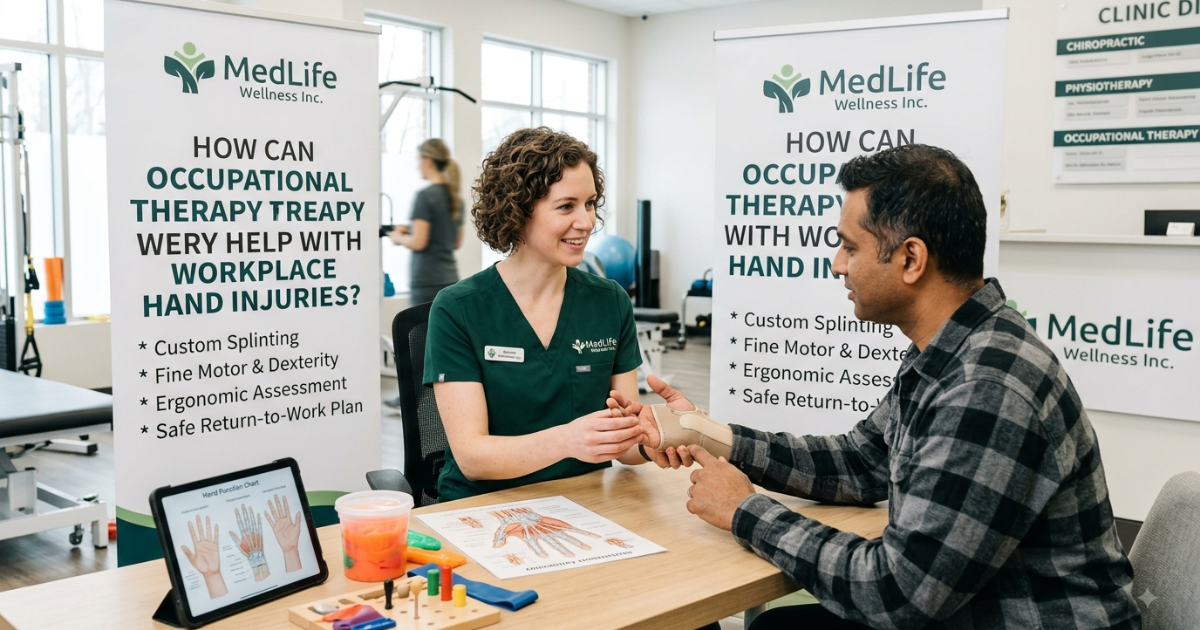
Our hands are our primary interface with the world. From typing on keyboards, assembling machinery, holding medical instruments, to operating heavy construction tools, hands perform thousands of complex movements every single working day. Because of their continuous usage and delicate anatomical structure, hands and wrists are exceptionally vulnerable to workplace accidents and repetitive strain injuries.
According to injury statistics published by workplace safety organizations like the Workplace Safety and Insurance Board (WSIB) and the Occupational Safety and Health Administration (OSHA), hand, finger, and wrist injuries account for nearly one-third of all workplace traumatic injuries. Whether caused by a sudden industrial accident such as a machinery crush injury, laceration, or tendon laceration or developed over years through repetitive micro-trauma like Carpal Tunnel Syndrome, a hand impairment can abruptly halt your career, independence, and daily quality of life.
Restoring hand function requires far more than basic resting or simple ice application. It demands a specialized clinical field that bridges medical healing with functional daily performance: Occupational Therapy.
At MedLife Wellness Inc., our multidisciplinary team recognizes that true hand injury rehabilitation must restore both the biological tissue and the worker’s specific capability to perform their job duties safely and efficiently.
Occupational Therapy (OT) is a regulated healthcare profession dedicated to helping individuals perform the activities or “occupations” that give life meaning and economic independence. In the context of rehabilitation, “occupation” does not merely refer to your paid job; it encompasses self-care tasks, domestic responsibilities, typing, driving, and recreational hobbies.
When an employee sustains a hand injury, an Occupational Therapist evaluating the case looks beyond anatomical damage. They assess how the physical injury disrupts specific functional tasks. Occupational Therapists who specialize in upper extremity rehabilitation possess advanced knowledge of human hand anatomy, kinesiology, wound healing, biomechanics, and ergonomic workplace dynamics.
Workplace hand injuries generally fall into two broad categories: acute traumatic injuries and chronic repetitive strain conditions. Occupational therapy effectively manages both:
Occupational therapy for workplace hand injuries employs a multi-faceted, evidence-based approach tailored to the specific tissue healing stage and the physical requirements of the patient’s job.
In the early stages of hand recovery, protecting fragile tissues, repaired tendons, or healing bone fractures is paramount. Occupational therapists design and custom-fabricate thermoplastic splints (orthoses) molded directly to the patient’s hand or wrist. Unlike rigid off-the-shelf braces, custom orthoses provide pinpoint immobilization while preserving movement in uninjured adjacent joints, minimizing joint stiffness and accelerating early functional recovery.
Post-traumatic swelling in the rigid compartments of the hand restricts range of motion, increases local tissue pressure, and leads to persistent joint stiffness. OT practitioners utilize specialized edema management strategies, including retrograde massage, manual lymphatic drainage techniques, high-grade compression garments, elevation protocols, and therapeutic thermal modalities.
Following surgery or deep lacerations, dense scar tissue can adhere to underlying tendons, nerves, and joint capsules, severely restricting finger flexion or extension. Occupational therapists utilize targeted scar tissue release, silicon gel sheeting, vibration therapy, cross-friction massage, and desensitization protocols to keep scars pliable and prevent permanent joint contractures.
Restoring hand movement involves systematic progression through passive range of motion (PROM), active-assisted range of motion (AAROM), and active range of motion (AROM). Once tissue integrity is re-established, therapists introduce progressive resistive exercises using therapy putty, hand exercisers, resistance bands, and specialized pinching tools to rebuild intrinsic hand muscle strength and pinch power.
Many workplace duties require intricate hand coordination such as threading small screws, typing rapidly, operating electronic dials, or assembling delicate components. OT rehabilitation includes fine motor dexterity drills, sensory re-education protocols for nerve-damaged fingers, and bi-manual coordination exercises that simulate real-world working conditions.
Because the clinical presentation of an acute crush injury differs significantly from a chronic overuse condition, occupational therapy interventions are tailored accordingly:
| Injury Type | Primary Symptoms | Key OT Focus Areas | Typical OT Rehabilitation Goal |
| Acute Traumatic Injury (e.g., Tendon Repair, Bone Fracture) | Sharp pain, severe edema, surgical incisions, structural instability, nerve loss. | Custom protective splinting, surgical wound care, scar pliability, controlled passive mobilization. | Protect structural repair, restore anatomical range of motion, prevent tendon adhesions. |
| Repetitive Strain Injury (e.g., Carpal Tunnel, Tenosynovitis) | Aching pain, numbness/tingling in fingers, weak grip, nocturnal awakening. | Ergonomic workstation modification, nerve/tendon gliding exercises, activity pacing, nocturnal splinting. | Reduce nerve compression, eliminate repetitive micro-trauma, optimize joint mechanics. |
A central pillar of occupational therapy that sets it apart from traditional physical therapies is its direct emphasis on environmental modification. Healing the hand while sending the worker back into the exact un-adapted physical environment that caused the injury invites re-injury.
Occupational therapists conduct thorough ergonomic workplace evaluations to identify physical hazard factors, such as awkward wrist angles, excessive pinch force, repetitive mechanical stress, or high vibration tools. Based on these findings, the therapist implements tailored modifications:
Complex hand injuries frequently impact broader anatomical structures, such as the forearm, shoulder, upper back, and neck. At MedLife Wellness Inc., we utilize an integrated care approach, combining occupational therapy with our full suite of rehabilitation services:
Returning to work after a serious hand injury requires a structured, safe progression. Occupational therapists guide both the employee and employer through a four-stage process:
Stage 1: Acute Protection and Tissue Healing
Focuses on controlling inflammation, protecting surgical repairs through splinting, maintaining non-injured joint mobility, and managing post-traumatic pain.
Stage 2: Functional Recovery and Dexterity Building
Introduces progressive strengthening, fine motor skill exercises, scar tissue mobilization, and task-specific simulations in the clinic.
Stage 3: Work Simulation and Capacity Testing
Evaluates the patient’s physical capacity using simulated work tasks (e.g., carrying weight, pinching fasteners, using screwdrivers, continuous typing) to ensure the hand can handle job demands without symptom flares.
Stage 4: Modified Return-to-Work and Gradual Duties
Collaborates with employers and insurance platforms (like WSIB) to establish a modified-duty plan. The worker resumes light duties with clear restrictions on lifting, gripping, or repetitive hours, gradually building up to full-capacity employment.
If you have suffered a workplace hand or wrist injury, early therapeutic intervention significantly improves long-term outcomes and reduces the risk of chronic disability. You should consult an Occupational Therapist if:
Medical Disclaimer: The information provided in this article is for educational and informational purposes only and is not intended as medical advice. Always seek the advice of a qualified healthcare provider regarding any medical condition or treatment plan. Never disregard professional medical advice or delay seeking it because of something you have read on this site.
Don’t let a workplace hand or wrist injury jeopardize your career and daily independence. Book a specialized rehabilitation assessment with our experienced team at MedLife Wellness Inc. today.
Schedule Your Occupational Therapy Assessment at MedLife Wellness Inc. or call our Brampton clinic directly at 437-595-1600.