
Welcome to the professional physiotherapy clinic
- Unit- 607, 2250 Bovaird Dr E, Brampton, ON, L6R 0W3
Welcome to the professional physiotherapy clinic
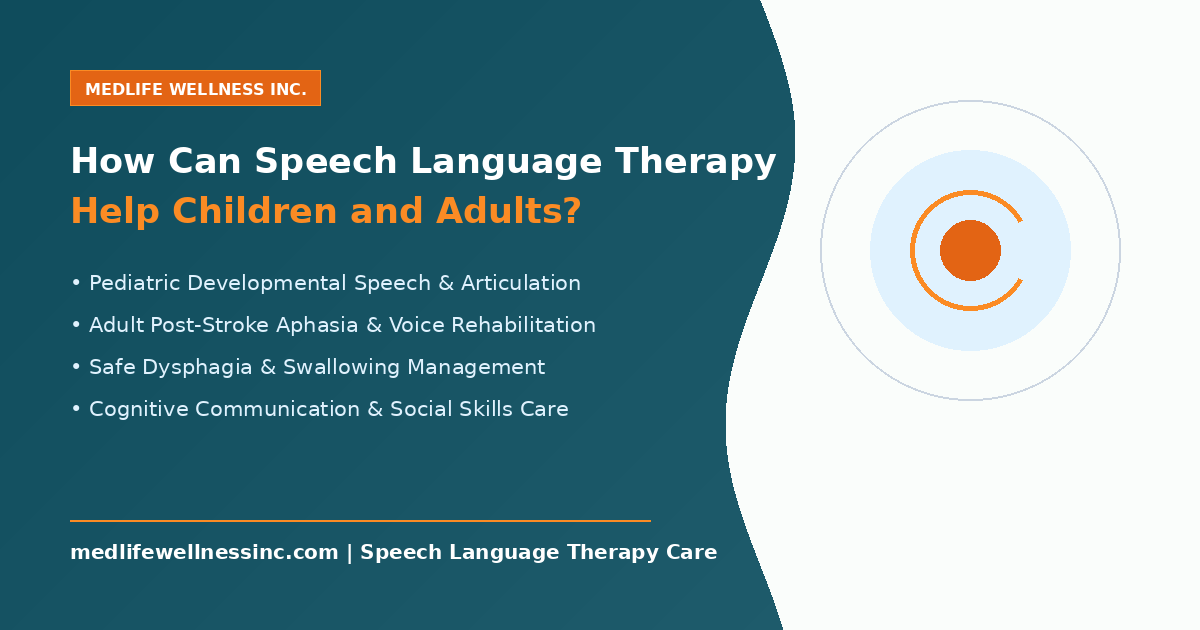
Communication is fundamental to human connection. It allows us to express our thoughts, share emotions, excel at school or work, and build meaningful relationships. Likewise, safe swallowing is essential for basic nutrition and enjoyment of life. When speech, language, or swallowing functions become impaired, the emotional, social, and functional impacts can be profound.
According to epidemiological clinical research from the American Speech-Language-Hearing Association (ASHA) and health databases indexed by the World Health Organization (WHO), roughly 8% of young children experience speech or language disorders, while millions of adults suffer from acquired communication or swallowing impairments due to stroke, neurodegenerative conditions, or physical trauma.
Speech-Language Pathologists (SLPs) are specialized healthcare professionals trained to assess, diagnose, and rehabilitate these conditions. At MedLife Wellness Inc., our evidence-based Speech Language Therapy programs provide personalized intervention tailored to the unique developmental or restorative goals of every child and adult.
In pediatric care, early intervention is critical. A child’s brain possesses remarkable neuroplasticity during early development, making early speech-language therapy highly effective for overcoming developmental hurdles.
Many children struggle to form specific speech sounds correctly (such as “r”, “s”, “l”, or “th”). Articulation therapy helps children learn precise tongue and lip placement, while phonological therapy targets patterns of sound errors, ensuring their speech becomes clear and intelligible to family, teachers, and peers.
Children with receptive language challenges struggle to understand instructions, process spoken words, or answer questions. Those with expressive language delays know what they want to say but struggle to put words together into grammatically correct sentences. Speech therapy uses play-based activities and visual schedules to build vocabulary and sentence structure.
Stuttering involves disruptions in the flow of speech, such as sound repetitions, prolongations, or silent blocks. Speech therapists teach children breathing techniques, gentle onset strategies, and speech modification tools to build confidence and smooth speech delivery.
Children on the autism spectrum or those with social communication difficulties often struggle with conversational turn-taking, interpreting non-verbal cues, making eye contact, or understanding figurative language. Pragmatic therapy builds social awareness and peer interaction skills in structured, supportive settings.
While pediatric therapy often focuses on developmental skill acquisition, adult speech therapy frequently targets skill restoration or adaptive management following illness, injury, or neurological decline.
Aphasia is a language disorder resulting from damage to the brain’s language centers (commonly following a stroke). Speech therapy helps adults rebuild speaking, reading, writing, and comprehension capabilities through specialized neuro-rehabilitation exercises, gesture training, and alternative communication tools.
Neurological conditions such as Parkinson’s disease, ALS, Multiple Sclerosis, or stroke can weaken or uncoordinate the muscles used for speech. SLPs utilize vocal loudness training (such as Lee Silverman Voice Treatment principles), oral-motor strengthening, and pacing techniques to restore speech clarity.
Difficulty swallowing (dysphagia) poses severe health risks, including aspiration pneumonia, malnutrition, and dehydration. Speech therapists conduct specialized clinical evaluations to prescribe safe diet textures, head positioning strategies, and neuromuscular swallowing exercises that restore safe eating and drinking.
Traumatic brain injury (TBI) or early-stage dementia can impair memory, executive functioning, problem-solving, and attention. Speech therapy equips adults with cognitive retraining strategies and compensatory memory tools to maintain independence in daily living.
| Focus Area | Pediatric Speech Therapy | Adult Speech Therapy |
| Primary Clinical Goal | Developmental skill acquisition & academic readiness. | Functional skill restoration & safe independence. |
| Key Conditions Treated | Speech delays, autism, stuttering, articulation errors. | Stroke/aphasia, Parkinson’s, TBI, dysphagia, voice loss. |
| Treatment Modalities | Play-based games, storybooks, visual aids, sound repetition. | Cognitive exercises, vocal drills, swallowing maneuvers. |
| Family Involvement | Parental coaching for home-based language modeling. | Caregiver training for communication & safe feeding. |
At MedLife Wellness Inc., we recognize that communication and motor functions are deeply connected to overall physical and mental health. Our multidisciplinary care model ensures comprehensive recovery:
Knowing when to seek professional assistance can dramatically alter treatment outcomes. Consider scheduling a professional consultation if you notice any of the following signs:
For Children:
For Adults:
Clinical Disclaimer: The information provided in this publication is for educational purposes only and should not replace clinical diagnosis. If you suspect an acute neurological event like a stroke (manifested by face drooping, arm weakness, or sudden slurred speech), seek emergency medical services immediately.
Whether helping your child find their voice or helping an adult loved one regain independence, the expert clinical team at MedLife Wellness Inc. in Brampton is ready to help.
Book a Speech Language Therapy Assessment Today or call our clinic directly at 437-595-1600.